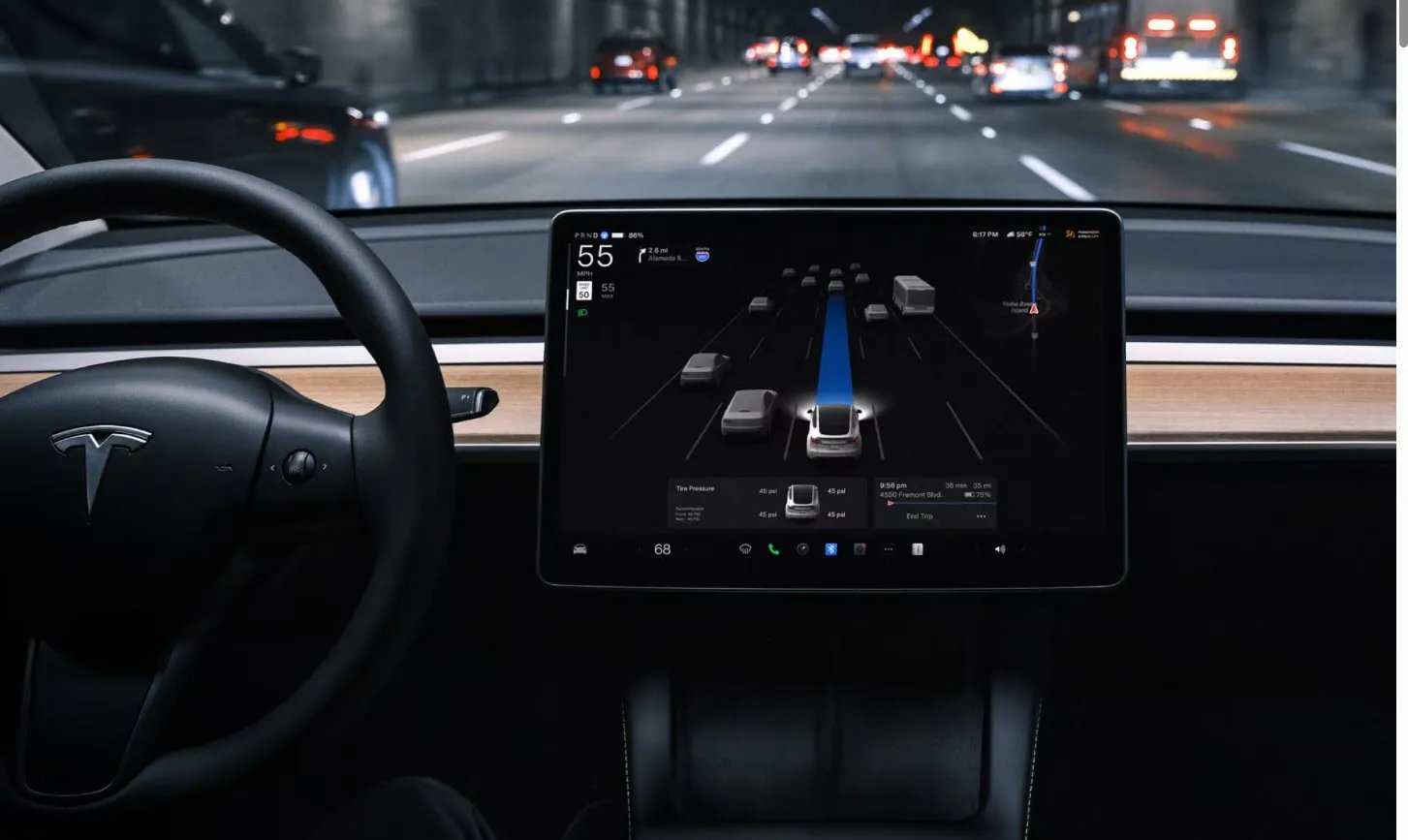
🤖 FSD V12: The Final Word in AI? What the New Update Changes for Autonomous Driving
For years, the promise of true Full Self-Driving (FSD) has been Tesla’s most ambitious, and arguably most controversial, long-term goal. With the ongoing rollout and refinement of FSD Beta, every new version sparks intense debate. But the arrival of FSD V12 marks a different kind of milestone.
This update isn’t just an incremental improvement; it represents a significant architectural shift that could fundamentally change how autonomous vehicles learn and operate. For Tesla Mag readers, let’s break down why FSD V12 is being heralded as a potential turning point—and what it truly changes for the driver.
The Big Shift: From Explicit Coding to Neural Nets
Previous versions of FSD, from V1 through V11, relied heavily on explicit C++ coding. Engineers had to manually write rules for virtually every scenario: If you see a traffic light turning yellow, then begin deceleration. If a pedestrian is here, then calculate a buffer zone.
FSD V12 throws out the rulebook.
- End-to-End Neural Network: The key architectural change is the transition to a purely end-to-end video-in, controls-out neural network. This means the system takes raw camera data and directly outputs steering, acceleration, and braking commands, bypassing most of the complex, hand-coded logic layers.
- Training on Video: Instead of being told how to drive in every situation, the V12 model is trained almost exclusively on millions of miles of high-quality video footage captured by Tesla’s fleet, essentially learning to drive like a human by watching humans drive.
💡 Why this matters: The system is learning nuanced human behavior—the subtle creep at an unmarked intersection, the way a driver positions the vehicle to prepare for a turn—which is incredibly difficult to capture with hard-coded rules.
Driving Experience: What the Beta Testers are Seeing
The most noticeable improvements reported by beta testers revolve around two key areas: naturalness and handling complex edge cases.
1. Smoother, More Human-Like Maneuvers
FSD V12 is far less robotic and jerky than its predecessors.
- Reduced ‘Ping-Pong’: Vehicles are holding their lane positions more naturally, reducing the tendency to “ping-pong” between lane lines.
- Better Turning: Turns, especially unprotected left turns, are executed more confidently and with better positioning, eliminating the hesitation that plagued older versions.
- Speed Management: The system handles speed limits and zones more fluidly, feeling less like it’s strictly calculating a speed number and more like it’s responding to the surrounding traffic flow.
2. Mastering Ambiguity
The system is proving much more adept at navigating scenarios without explicit, clear rules.
- Construction Zones: Navigating confusing or changing lane markings in construction areas is significantly improved.
- Unusual Road Furniture: The system is better at interpreting temporary traffic signals or unexpected obstacles without simply freezing or disengaging.
- Visual Recognition: Since the core AI is processing video contextually, it’s better at spotting subtle visual cues, like a police officer directing traffic or a construction worker flagging a detour.
The Future of FSD: Is This the Final Word?
While V12 is a massive leap, the term “Final Word” in AI is ambitious. There are still challenges to overcome:
| Challenge | Impact on FSD V12 |
| Regulation | Regulatory Approval: The system still requires significant regulatory approval to move beyond “Beta” status and into an unsupervised mode. |
| Adversarial Scenarios | True Edge Cases: The system must be proven safe for extreme, rare events—an area where even massive video training must be supplemented by rigorous testing. |
| Hardware | Legacy Hardware: Older vehicles still running FSD Beta with the original Autopilot Hardware 2.0/2.5 may not fully leverage the end-to-end architecture compared to newer vehicles. |
Conclusion: FSD V12 is arguably the most exciting development in Tesla’s autonomous journey. By transitioning to a pure AI, vision-based approach, Tesla has unlocked a pathway to human-like driving behavior that previous rule-based systems simply could not achieve. It’s not the end of the road, but it confirms that Tesla is fundamentally betting on neural networks and vast data to solve autonomy.