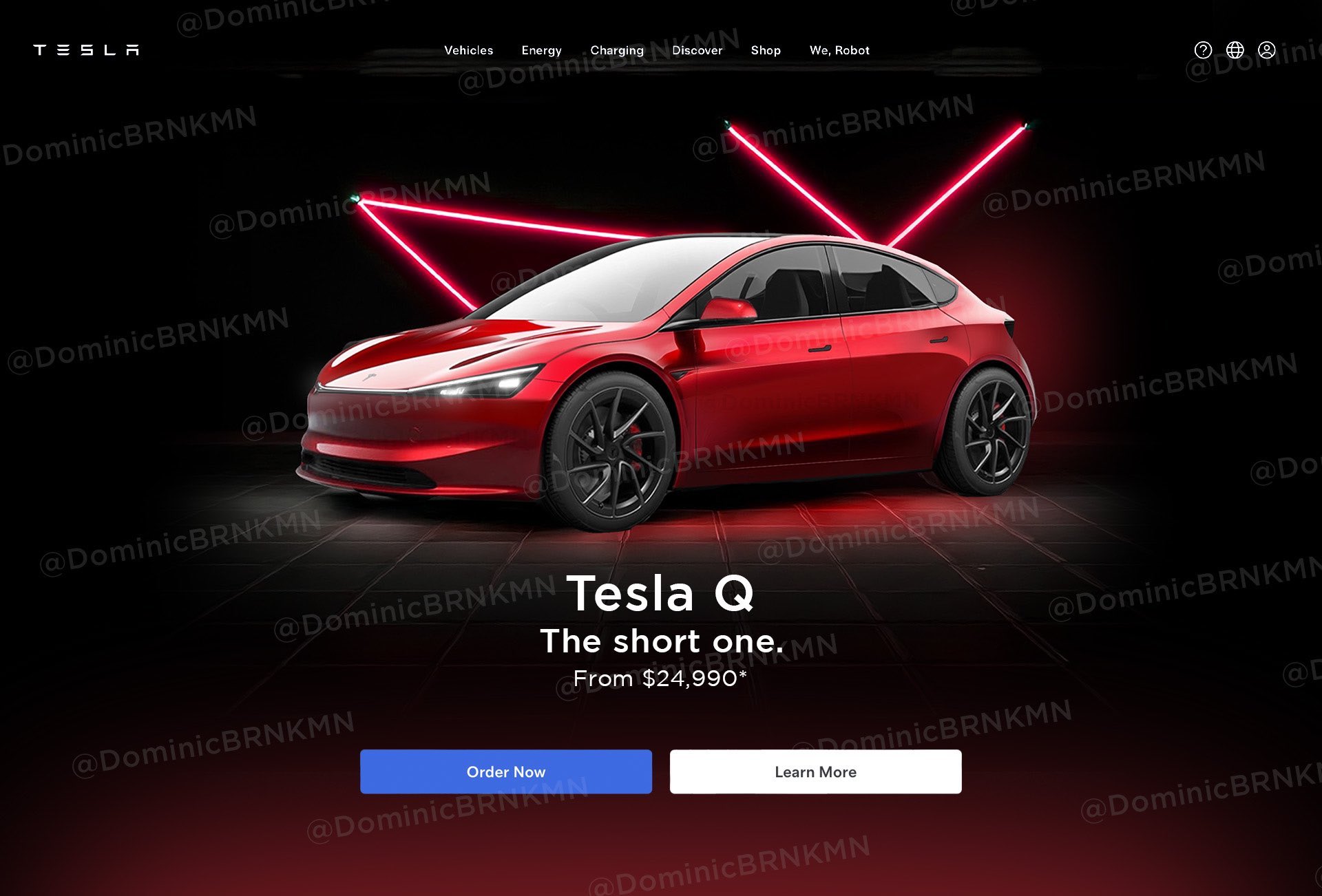
🤯 The Next Big Thing: Tesla’s $25K Car is Real—Here’s the Global Impact
The era of truly affordable electric vehicles (EVs) is about to begin, and the shockwave is emanating from Palo Alto. While legacy automakers struggle to cut costs, Tesla is set to deliver a major blow with its entry-level vehicle, widely dubbed the “Model 2” or referred to by the internal project name “Redwood.”
A long-standing promise from Elon Musk, this car, priced around the $25,000 mark, is no longer a myth. It is a cornerstone of the company’s future strategy, aiming to fulfill its mission: accelerating the world’s transition to sustainable energy.
💰 A Shock Price, a Production Revolution
How can Tesla offer an EV with its Supercharger network access and cutting-edge software at a price that fiercely competes with internal combustion engine (ICE) city cars? The answer lies in the “next-generation platform” and extreme industrialization:
- Next-Gen Gigapress Utilization: The use of massive Gigapress machines to cast large sections of the chassis as a single piece drastically reduces component count, assembly time, and, critically, production costs.
- Novel Architecture: The vehicle will be built on a dedicated, smaller platform, roughly 20% more compact than the Model 3, optimized for efficiency and lightness.
- Cheaper Battery and Motor Tech: Utilizing less expensive Lithium Iron Phosphate (LFP) batteries and new ferrite-magnet motors (cheaper than traditional permanent magnets) allows for significant cost reduction in the battery pack without sacrificing the necessary daily driving range.
🌍 The Global Impact: Three Markets Under Siege
The arrival of this low-cost model won’t just be an addition to Tesla’s catalog; it will be an economic and industrial “tsunami,” especially impacting three key global markets.
1. Europe: EVs Go Truly Mass Market
The European market is currently seeing the rise of more affordable EV models (like the Renault 5 E-Tech or the Citroën ë-C3). However, the introduction of a $25,000 Tesla (potentially manufactured at Gigafactory Berlin) will create enormous pressure:
- Democratization: It makes a high-performance EV, backed by the superior Supercharger infrastructure, accessible to the middle class, young professionals, and corporate fleets.
- Pressure on Legacy Automakers: European manufacturers (VW, Renault, Stellantis) will be forced to drastically accelerate their own low-cost EV projects and may struggle to compete on a feature-to-price basis.
2. Asia: Challenging the Dominant Player
In China and Southeast Asia, the market is dominated by affordable local electric brands like BYD. Tesla’s $25,000 car is designed to directly challenge this dominance, particularly in the high-volume compact segment:
- Direct Competition: It will allow Tesla to capture market share from domestic Chinese brands that currently hold the cost advantage.
- Global Export Hub: If production focuses on Gigafactory Shanghai, this model will become a massive export driver across the Asian Pacific, disrupting traditional Japanese and Korean exports.
3. The United States: Replacing the Entry-Level ICE
In the U.S., the $25,000 price point is critical as it directly competes with popular gasoline-powered models like the Honda Civic and Toyota Corolla.
- First-Time EV Buyers: This pricing will entice millions of customers who have been waiting for an affordable, quality EV without range anxiety.
- EV Market Share Spike: It will be the single most important factor in accelerating EV adoption, pushing the U.S. past its current adoption plateaus.
📈 Bottom Line: The Race for Scale
The $25,000 Tesla isn’t just about making money on a single car; it’s about scale and infrastructure. By doubling its manufacturing volume, Tesla can lower the cost of its entire fleet (Model 3/Y included) and maximize the data collection necessary to perfect its Full Self-Driving (FSD) system.
The global automotive industry is on notice: the biggest catalyst for mass EV adoption is about to hit the streets.