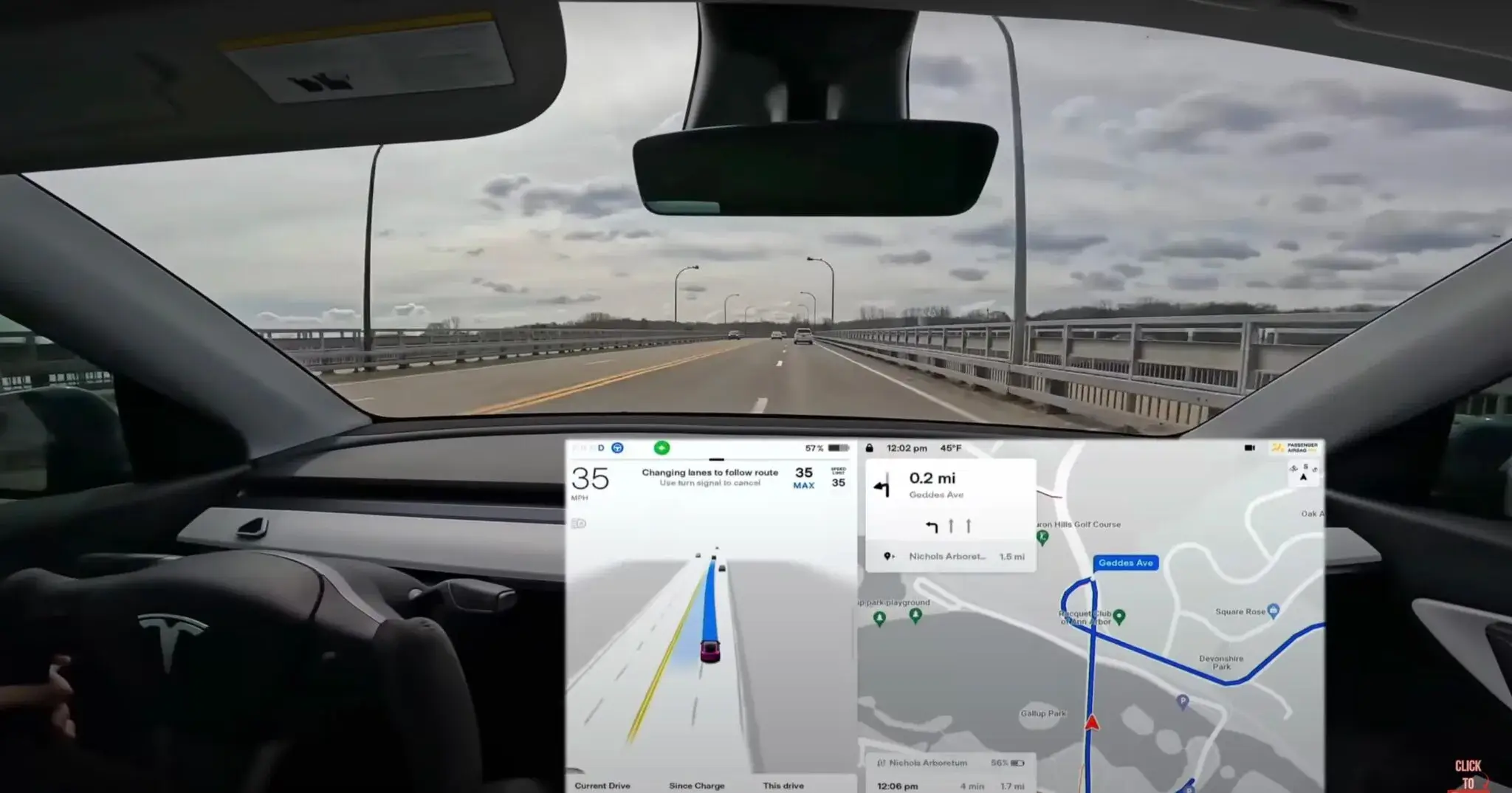
Tesla’s FSD V14.2.1: A Leap Towards Hands-Free Driving
The recent update of Tesla’s Full Self-Driving (FSD) software, specifically version 14.2.1, has sparked considerable interest across the UK. With Elon Musk hinting at the integration of a feature that allows drivers to text while driving, contingent upon the context of surrounding traffic, the notion of truly autonomous driving is inching closer than ever before.
Understanding the Latest FSD Update
The FSD V14.2.1 brings significant improvements designed to enhance the autonomous capabilities of Tesla’s electric vehicles. One of the groundbreaking aspects of this update is its ability to dynamically assess traffic conditions. This enables certain driver’s activities, like texting, to be permissible under safe conditions.
It’s crucial to understand that this update doesn’t mean drivers can indiscriminately engage in texting. The system is designed to analyse each driving scenario; if the algorithm deems the environment safe—for instance, during heavy traffic jams or while stopped at a red light—the feature can allow for limited interaction with a phone.
Implications for Road Safety
While the notion of texting while driving might raise eyebrows, especially among safety advocates, Tesla’s approach seems grounded in fostering driver accountability while leveraging technology to enhance safety. The goal is to minimize distractions during high-risk situations while allowing some flexibility when relative safety is assured. This aspect of FSD V14.2.1 could potentially pave the way for broader acceptance of semi-autonomous driving features in the UK.
Regulatory Outlook in the UK
The introduction of such a feature undoubtedly raises questions about its reception among UK regulators. The Driver and Vehicle Standards Agency (DVSA), which governs driving regulations, has previously stated a cautious stance towards autonomous technologies. However, given the complex assessment capabilities of Tesla’s new software, there might be a necessity for updated legislation to accommodate these technological advancements.
The current UK law strictly prohibits the use of handheld devices while driving. However, with Tesla’s FSD advancements, there might be dialogue surrounding exceptions where autonomous technology sufficiently mediates driver input. As Tesla’s technology continues to evolve, so too must our legal frameworks to ensure both innovation and public safety.
A Glimpse Into the Future
This latest progression of Tesla’s FSD is a promising step towards the company’s ultimate goal: a vehicle that can operate completely autonomously without supervision from a human driver. While we are still on the cusp of this breakthrough, version 14.2.1 offers a hint of the potential future awaiting the automobile industry.
The profound impacts of such a transformation would extend beyond mere convenience. The shift towards fully autonomous vehicles could lead to enhanced efficiency, reduced traffic congestion, and possibly a significant decrease in road accidents—potential benefits widely appreciated within the UK.
Conclusion
As Tesla continues to push the boundaries of what’s possible with autonomous driving technology, the dynamics of driving in the UK are poised for change. The FSD V14.2.1 update not only symbolizes progress in automotive technology but also invites a broader discourse on how we, as a society, adapt to such rapid technological evolution. The journey towards fully unsupervised driving remains a pioneering frontier, and Tesla is steering us ever closer.