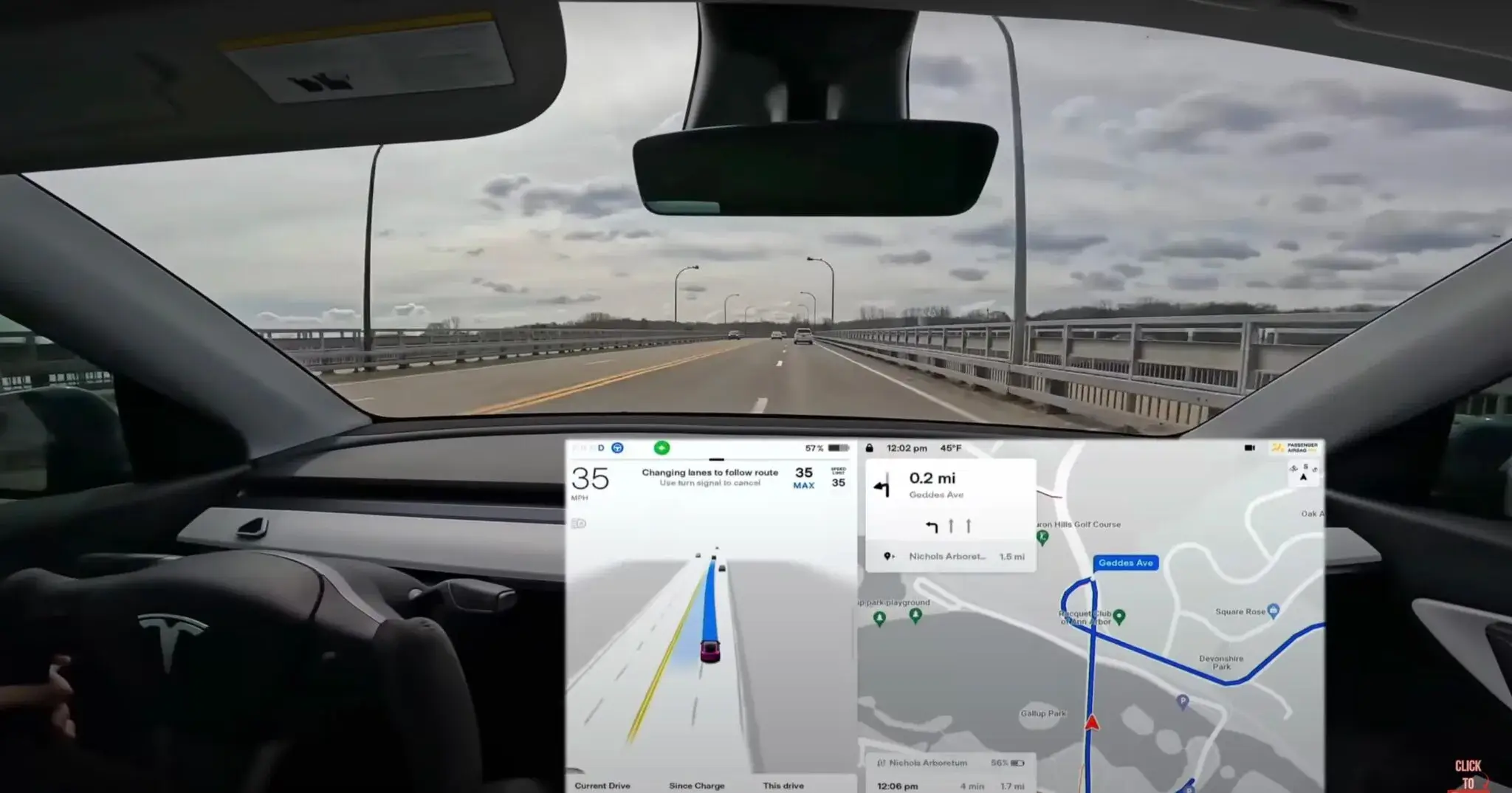
Revolutionary AI Transformations in Tesla’s Visual Navigation Systems
Tesla has once again demonstrated its pioneering spirit in the automotive world by revealing a groundbreaking artificial intelligence innovation that could reshape how autonomous vehicles perceive the world. Patent number WO 2025/193615 unveils an architecture that equips Tesla vehicles’ cameras with the ability to perform tasks previously reliant on expensive hardware like LiDAR.
The Evolution of Tesla’s Sensory Systems
Traditional autonomous vehicle systems frequently depend on sensors such as LiDAR and radar to accurately map their surroundings. These sensors provide depth and distance information, allowing cars to navigate safely through complex environments. However, they come at a significant cost, both financially and in terms of weight and power consumption.
The Vision-AI Leap Forward
Tesla’s new patent introduces a system where standard 2D cameras are transformed into 3D mapping tools, achieving precision previously thought possible only with hardware-based depth sensors. This leap is accomplished through an advanced AI model that deduces spatial data from 2D images, thereby creating a detailed 3D map of the environment without the need for additional hardware.
Behind the AI Magic: Voxels and Occupancy Networks
At the core of Tesla’s AI architecture is a technique that divides the space surrounding the vehicle into a grid of three-dimensional units known as voxels. The AI assigns each voxel an occupancy attribute, indicating whether it contains an object or is free space. This process enables the system to construct an accurate digital representation of the vehicle’s surroundings.
Training the AI: Learning from Sensor Data
The AI model is rigorously trained using datasets that pair camera footage with high-fidelity 3D sensor readings. By repeatedly comparing these flat images with a 3D reality, the AI learns visual signatures that signify depth. Once trained, it can make highly accurate inferences about the 3D world using only camera inputs, bypassing the need for costly sensors.
Advanced 3D Mapping and Real-Time Analysis
The system predicts intricate details such as the signed distance values of occupied voxels, allowing it to understand the precise boundaries of objects. Beyond static object detection, the AI generates a mesh of the driving surface, distinguishing various material types and elevations, essential for safe navigation across different terrains.
Intelligent Surface and Object Discovery
This intelligent mapping extends beyond basic occupancy recognition. The AI can discern surface types and grade inclines, ensuring that the vehicle navigates smoothly, whether it’s detecting a driver-friendly road or an obstacle-laden path.
Assisted Parking: The Future of Convenience
A notable application of this technology is its ability to enhance parking experiences. By reconstructing parking lot environments through visual cues like paint lines and other vehicles’ positions, Tesla’s system can autonomously guide the vehicle to choose optimal parking spots.
User Experience and Driver Engagement
The technology also promises to enrich driver engagement by displaying real-time navigation feedback. A layering protocol translates voxel data into vivid, easy-to-understand visualizations on the dashboard, giving drivers a comprehensive view of their vehicle’s interaction with the environment.
This revolutionary approach not only highlights Tesla’s commitment to innovation but also paves the way for more accessible, cost-effective autonomous driving technologies across the automotive industry.