Tesla Powerwall: The Patent That Changes Everything for Home Energy Autonomy
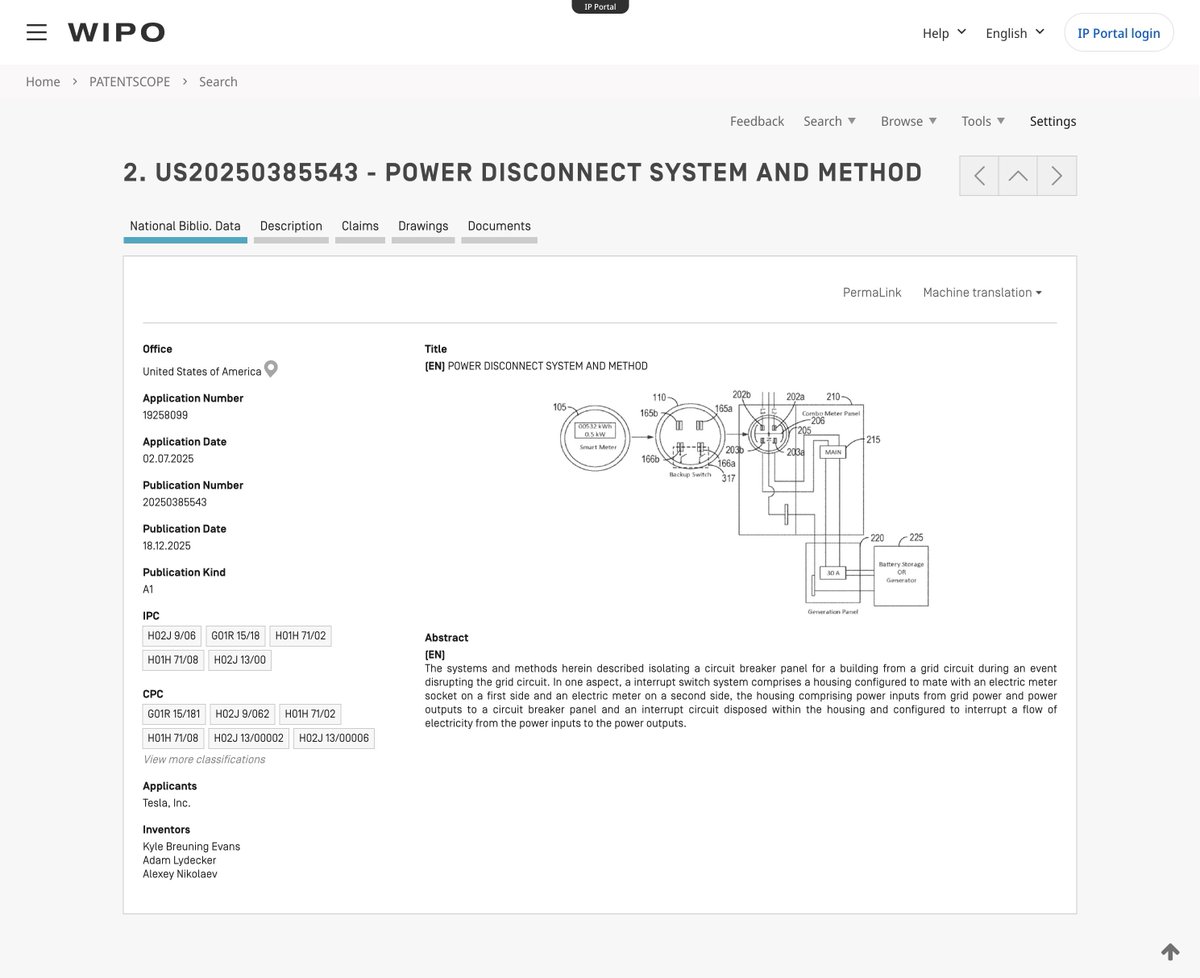
For years, installing a home battery was the “bottleneck” of the residential energy transition. Costly, complex, and often requiring a complete overhaul of the electrical panel, it discouraged many homeowners. However, on December 18, 2025, Tesla released a patent (US 2025/0385543 A1) promising to transform this chore into a simple “Plug-and-Play” operation.
Here is how this intelligent adapter and the new Powerwall 3 are redefining the rules of the game.
A Revolutionary Adapter: Installation in 60 Minutes
The heart of this innovation is a “Meter Collar” (intelligent adapter). Instead of dismantling the main electrical panel to install a bulky transfer switch, Tesla’s device plugs directly between your utility meter and its socket.
Why is this a technological breakthrough?
- Zero Structural Modification: No more drilling through walls or rewiring critical circuits.
- Robust Design: IP67 certified, the adapter uses specialized clamps to withstand extreme climates, dust, and flooding.
- Massive Savings: By eliminating the need for a separate external Gateway and reducing labor time by over 80%, installation costs drop by thousands of dollars.
Powerwall 3: Raw Power for the Modern Home
This adapter is the perfect companion for the Powerwall 3, the most capable battery Tesla has ever designed. While the capacity remains at 13.5 kWh, everything else has been supercharged:
- 11.5 kW Continuous Power: This is double the output of the Powerwall 2. It means a single battery can now simultaneously power an oven, a heat pump, and an EV charger.
- Integrated Hybrid Inverter: Powerwall 3 directly manages your solar panels (with 6 MPPT inputs), eliminating the need for expensive and fragile third-party inverters.
- LFP Chemistry (Lithium Iron Phosphate): More durable and safer, this technology allows the battery to be charged to 100% daily without premature degradation.
Technical Specifications: Powerwall 3 vs. Powerwall 2
| Feature | Powerwall 2 | Powerwall 3 |
| Energy Capacity | 13.5 kWh | 13.5 kWh |
| Continuous Power | 5 kW | 11.5 kW (More than double) |
| Peak Power (10s) | 7 kW | 18.5 kW |
| Solar Inverter | External Required | Integrated (6 MPPT inputs) |
| Round-Trip Efficiency | 90% | 97.5% |
| Cell Chemistry | Lithium NMC | LFP (Lithium Iron Phosphate) |
Embedded Intelligence: Reacting Before the Lights Flicker
The adapter does more than just move energy. It features Rogowski coils—ultra-precise sensors that monitor electrical flow in real-time.
In the event of a grid failure, the system detects the anomaly in milliseconds. Using electromechanical relays, it physically disconnects the house from the grid (“islanding”) and switches to battery power so fast that even your most sensitive electronics won’t shut off.
Profitability: A Faster Return on Investment (ROI)
With rising electricity prices, the Powerwall 3 combined with this adapter becomes a formidable financial tool based on three pillars:
1. Reduced Initial Investment (CAPEX)
- Hardware Savings: No need for a separate Gateway (saving ~$1,000–$1,500).
- Labor Savings: Installation time drops from 8–12 hours to under 2 hours, saving ~$800–$1,500 in specialized labor.
- Total Impact: The entry price for a functional system is reduced by approximately $2,500 compared to previous generations.
2. Time-of-Use Arbitrage
The battery acts as an automated energy trading tool:
- Off-Peak Charging: Buy electricity at night when it’s cheapest (e.g., $0.12/kWh).
- Peak Discharging: Power your home during expensive evening peaks (e.g., $0.25/kWh).
- Gain: For a household using 10 kWh during peak hours, this saves roughly $470 per year, even without solar panels.
3. Virtual Power Plants (VPP)
In compatible regions, Tesla pays you to stabilize the national grid. By letting the utility tap into a small portion of your battery during peak demand, users can earn between $100 and $800 per year, depending on the state and program.
Estimated ROI Summary (10-Year Outlook)
| Item | Estimated Value (10 Years) |
| Installation Cost (PW3 + Adapter) | ~$8,500 (After tax credits/rebates) |
| Bill Savings (Self-Consumption + Arbitrage) | ~$11,000 |
| VPP Passive Income | ~$1,500 |
| Net 10-Year Profit | + $4,000 |
Conclusion: Energy Independence for Everyone?
By simplifying installation, Tesla has removed the final psychological and financial barrier to home energy storage. This patent isn’t just about a metal box; it marks the transition of the home battery from a “niche gadget” to a standard household appliance, just like a water heater or a refrigerator. With an estimated break-even point of 7 to 9 years, the Powerwall 3 offers a decade of pure profit and total peace of mind against rising energy costs.