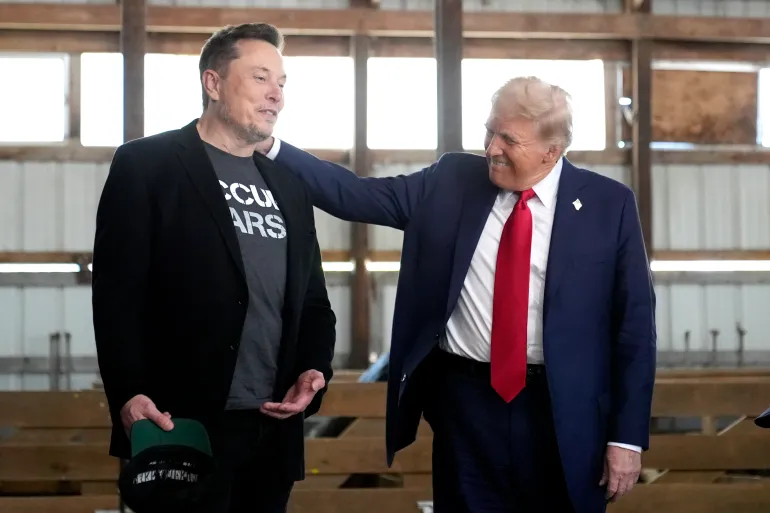
Tesla Optimus, Trump & Elon Musk and Starlink are in the news today
Tesla has shifted the center of gravity of innovation. It has moved from being an electric vehicle pioneer to becoming a multi-layer technological empire powered by robotics, artificial intelligence, energy systems, and global connectivity infrastructure. Through its ecosystem, Tesla challenges the status quo, sparking debates that redefine mobility and society’s relationship with machines.
This article interconnects and elevates the core themes explored in Tesla Mag, providing clear entry points to each pillar of disruption.
1. Robotics: Redefining Human-Like Motion Without Replicating Humanity
Tesla’s Optimus embodies a new era of locomotion engineering. Unlike conventional humanoid robotics, Tesla’s approach proves that machines don’t need to imitate biological limitations to move with agility. The science of bipedal locomotion is being reinvented using AI-driven balance modeling, real-time torque distribution, and motion optimization.
Explore this insight in:
The advanced mechanics behind Tesla’s bipedal robotic running2. Accessibility: Language as the Gateway to Adoption
A revolution that cannot be understood will never scale. Tesla recently expanded its UI usability, integrating additional languages into its system stack. This strategic move proves that technology acceptance is rooted in accessibility, not only performance.
Understand Tesla’s UX evolution in:
3. AI & Autonomy: The Eternal Pursuit of the Perfect Drive
Autonomy is philosophical before it is technological. With Full Self‑Driving, Tesla is not replacing the driver — it is evolving the nature of driving itself, transforming cars into predictive co-intelligences.
4. Power & Influence: When Tech Meets Political Friction
The relationship between Elon Musk and former U.S. President Donald Trump has shaped narratives beyond politics — impacting industrial momentum, AI regulatory frameworks, and perception of innovation worldwide.
5. Urban Autonomy Stress Test: Paris vs AI Driving
Tesla brought its AI into Europe’s wildest arena — Paris. Testing autonomy in chaotic traffic is more than a technical challenge, it’s a social proof of maturity.
6. Safety: Structural Innovation as a Moral and Engineering Mandate
Tesla continues rewriting the definition of protection through ultra-resilient vehicle architecture, crash energy dispersion, and AI-assisted risk anticipation.
7. The Energy Grid Layer: Sustainability Engineered, Not Declared
Change demands infrastructure. Tesla Mag recently explored the low-carbon alliance between:
- Verkor
- EDF
They prove that decarbonization must precede mass adoption.
8. Connectivity Beyond Borders: The Internet of Autonomous Machines
A self-driving world requires a self-connected world. Through its space connectivity arm:
- Starlink
- Recent expansion into South Korea
Tesla is preparing the global data layer needed for autonomous mobility.
9. The True Bottleneck: Autonomous Driving in Extreme Weather
Tesla is training AI for the world, not the lab. Extreme weather autonomy relies on reinforced sensors and neural weather perception.
Final Synthesis: Technology Advances Through Tension, Not Convenience
Tesla’s innovation pipeline is dialectic by essence:
| Thesis → Robots must run without copying humans
| Antithesis → Tech must speak every language to be adopted
| Synthesis → Cars must think without replacing thinkers
This multi-vector disruption shows a future where:
- Mechanics evolve through AI
- Adoption evolves through accessibility
- Autonomy evolves through adversity
- Sustainability evolves through alliances
- Connectivity evolves through space