The Tesla Cybertruck: When Arrakis Meets the Modern Road
This version of the article incorporates the advanced engineering milestones, such as the 48V architecture and the Bioweapon Defense Mode, positioning the Cybertruck as a vehicle built for survival in extreme environments.
Beyond the Horizon: The Cybertruck’s Engineering Leap into the Future
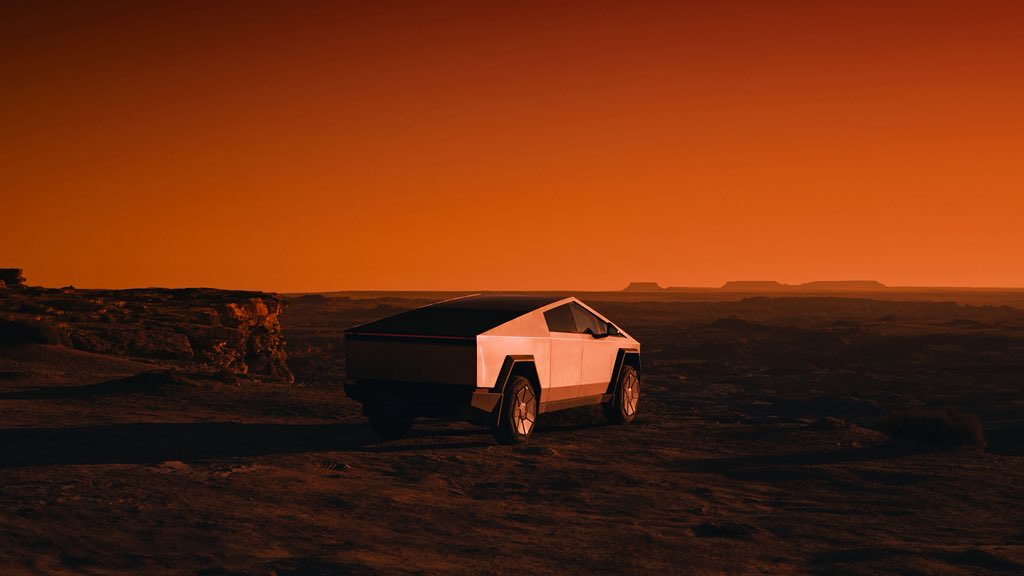
The recent viral imagery of the Tesla Cybertruck framed against a stark, desert backdrop has done more than just evoke the spice-filled dunes of Arrakis. It has sparked a conversation about the sheer technical audacity required to build a vehicle that looks—and acts—like a relic from the future. While its design is a nod to science fiction, its internal architecture is a radical departure from a century of automotive tradition.
A Biological Fortress in the Dust
In the harsh environments depicted in films like Dune, air is a precious resource. The Cybertruck mirrors this necessity with its Bioweapon Defense Mode. Equipped with a massive, hospital-grade HEPA filtration system, the vehicle removes 99.97% of airborne particles, including bacteria, viruses, and fine desert dust. When activated, the system creates positive pressure inside the cabin, effectively sealing the occupants inside a pressurized “clean room” that prevents outside contaminants from seeping through door seals.
The 48-Volt Revolution: Rewiring the Future
Perhaps the most significant factual milestone hidden beneath the stainless steel is the move to a full 48-volt low-voltage architecture. Since the 1950s, the automotive world has been stuck on a 12V standard. By quadrupling the voltage, Tesla has:
- Reduced Copper Usage: The higher voltage allows for thinner wires to carry the same amount of power, reducing the vehicle’s total wiring weight by approximately 70%.
- Enhanced Efficiency: This system powers the heavy-duty components—like the high-torque steering motors—with far greater efficiency than any previous pickup.
Mastering Hostile Terrain
To navigate the unpredictable geometry of a desert landscape, the Cybertruck utilizes an adaptive air suspension system with a specialized “Extract Mode.” This feature allows the truck to lift itself to a maximum ground clearance of 16 inches (40.6 cm), clearing obstacles that would snag the undercarriage of a standard off-road vehicle. With a 35-degree approach angle, it is engineered to climb steep embankments as easily as it cruises down a highway.
Survival and Range: The Long Haul
True exploration requires more than just power; it requires endurance. For those planning to venture far beyond the reach of the Supercharger network, Tesla introduced the Range Extender. This is an optional, secondary battery pack that fits into the bed of the truck, boosting the total range to over 470 miles (750+ km).
Furthermore, the truck serves as a mobile power grid. Its Powershare capability can export up to 11.5 kW of electricity. This means the Cybertruck isn’t just a transport vessel—it’s a life-support system capable of powering a remote campsite, heavy machinery, or even an entire home during an outage.
Conclusion: The New Standard for Innovation
The Cybertruck is not merely a “truck” in the traditional sense; it is a rolling laboratory of first-of-their-kind technologies. From the Steer-by-Wire system that removes physical steering linkages to the 48V electronics that redefine how cars are wired, Tesla has built a vehicle that feels alien because it belongs to a future that hasn’t arrived for anyone else yet. Whether on the streets of a modern city or the sands of a distant desert, the Cybertruck remains a symbol of an era where reality has finally caught up to imagination.
To complete your article, here is a detailed technical comparison between the Tesla Cybertruck and its two main rivals as of 2025: the Rivian R1T (the adventure-focused athlete) and the Ford F-150 Lightning (the traditionalist’s electric workhorse).
Technical Showdown: Cybertruck vs. The Competition
| Feature | Tesla Cybertruck (Cyberbeast) | Rivian R1T (Tri-Motor 2025) | Ford F-150 Lightning |
| 0-60 mph (0-96 km/h) | 2.6 Seconds | 2.7 Seconds | 3.8 – 4.1 Seconds |
| Max Range | 320 miles (440+ w/ Extender) | 420 miles | 320 miles |
| Towing Capacity | 11,000 lbs (4,990 kg) | 11,000 lbs (4,990 kg) | 10,000 lbs |
| Payload Capacity | 2,500 lbs (1,134 kg) | 1,764 lbs | 2,235 lbs |
| Max Ground Clearance | 16.0 inches | 14.6 inches | 8.4 inches |
| Approach Angle | 35 Degrees | 34 Degrees | 24.4 Degrees |
| Low-Voltage System | 48V (Next-Gen) | 12V (Traditional) | 12V (Traditional) |
Analysis: Where the Cybertruck Wins
1. The “Off-Road” King
While the Rivian R1T is a formidable adventure vehicle, the Cybertruck’s “Extract Mode” gives it a significant advantage in raw ground clearance ($16$ inches vs Rivian’s $14.6$). The Ford Lightning, being based on a traditional gas-truck chassis, sits much lower at $8.4$ inches, making it more suited for paved roads and light work sites than rock crawling or deep desert dunes.
2. Structural Efficiency
The Cybertruck is the clear winner in Payload. Thanks to its stainless steel exoskeleton, it can carry 2,500 lbs in its bed—significantly outperforming the Rivian and even the Ford. This makes it a more capable “beast of burden” despite its sci-fi appearance.
3. Modern Architecture
The transition to 48V architecture is a subtle but massive win for Tesla. While Ford and Rivian still use miles of heavy copper wiring required by 12V systems, the Cybertruck’s lean wiring harness makes it more efficient and easier to manufacture at scale.
4. Steering and Maneuverability
Tesla’s Steer-by-Wire combined with Rear-Wheel Steering allows the Cybertruck to have a tighter turning radius than its competitors, despite being longer than the Rivian. The Ford F-150 Lightning feels like a traditional truck to drive, whereas the Cybertruck maneuvers more like a nimble sports sedan.
Conclusion: Which one for Arrakis?
If you were actually on the planet Arrakis, the Cybertruck would be your choice for its pressurized Bioweapon Defense Mode and superior clearance. However, for a long-distance road trip without the optional “Range Extender,” the 2025 Rivian R1T still holds the crown for the best native battery range.